
OUR MISSION
Fourth Street Clinic delivers comprehensive, patient-centered healthcare to individuals facing homelessness, improving health with lasting impact.
HISTORY
Homelessness in Utah
The mid 1980s brought an economic revitalization to Salt Lake City’s downtown that included the demolition and redevelopment of many substandard housing units otherwise known as Single-Room Occupancy Hotels (SROs). The SROs were homes to Salt Lake’s lowest-income residents who often worked odd jobs within walking distance as janitors or watchmen. When the roughly 800 housing units were torn down, 1,000 residents were cut off from their homes and jobs. Prior homelessness in Utah was an isolated and temporary phenomenon. Now it can be predictable, intergenerational and permanent.
Over Three Decades of Homeless Health Care
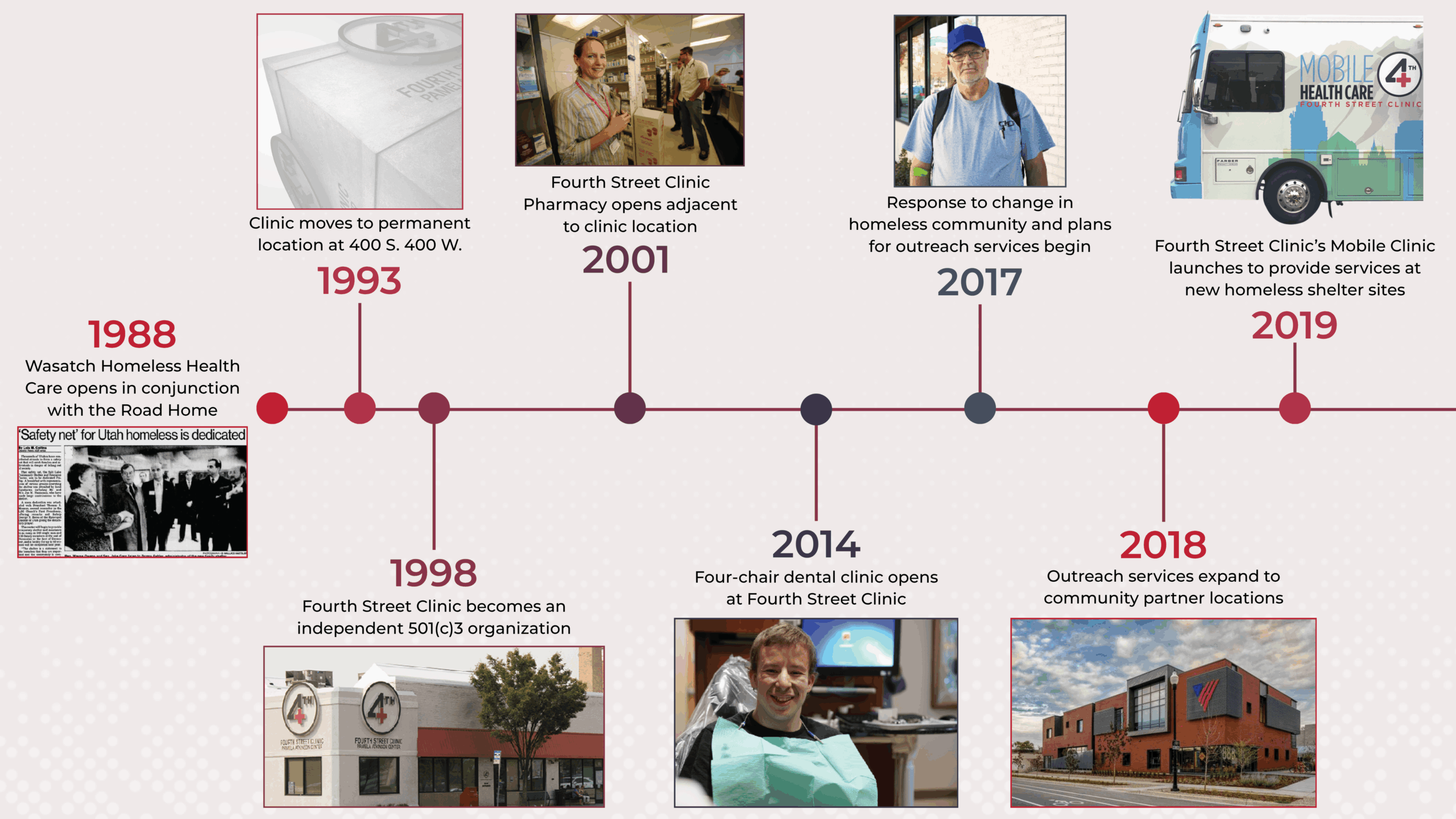
Wasatch Homeless Health Care, Inc., began in 1988 in a small office in the newly opened Salt Lake Community Shelter and Resource Center, now known as The Road Home, in the old Westinghouse Warehouse building on 210 S. Rio Grande Street. One part-time nurse coordinated medical services with local hospitals and provided health education and triaged care, overseen by Allan Ainsworth, founder of Wasatch Homeless Health Care.
Then in the early 90s, Wasatch Homeless Health Care purchased the building on the southwest corner of 400 West and 400 South, and Fourth Street Clinic was born.
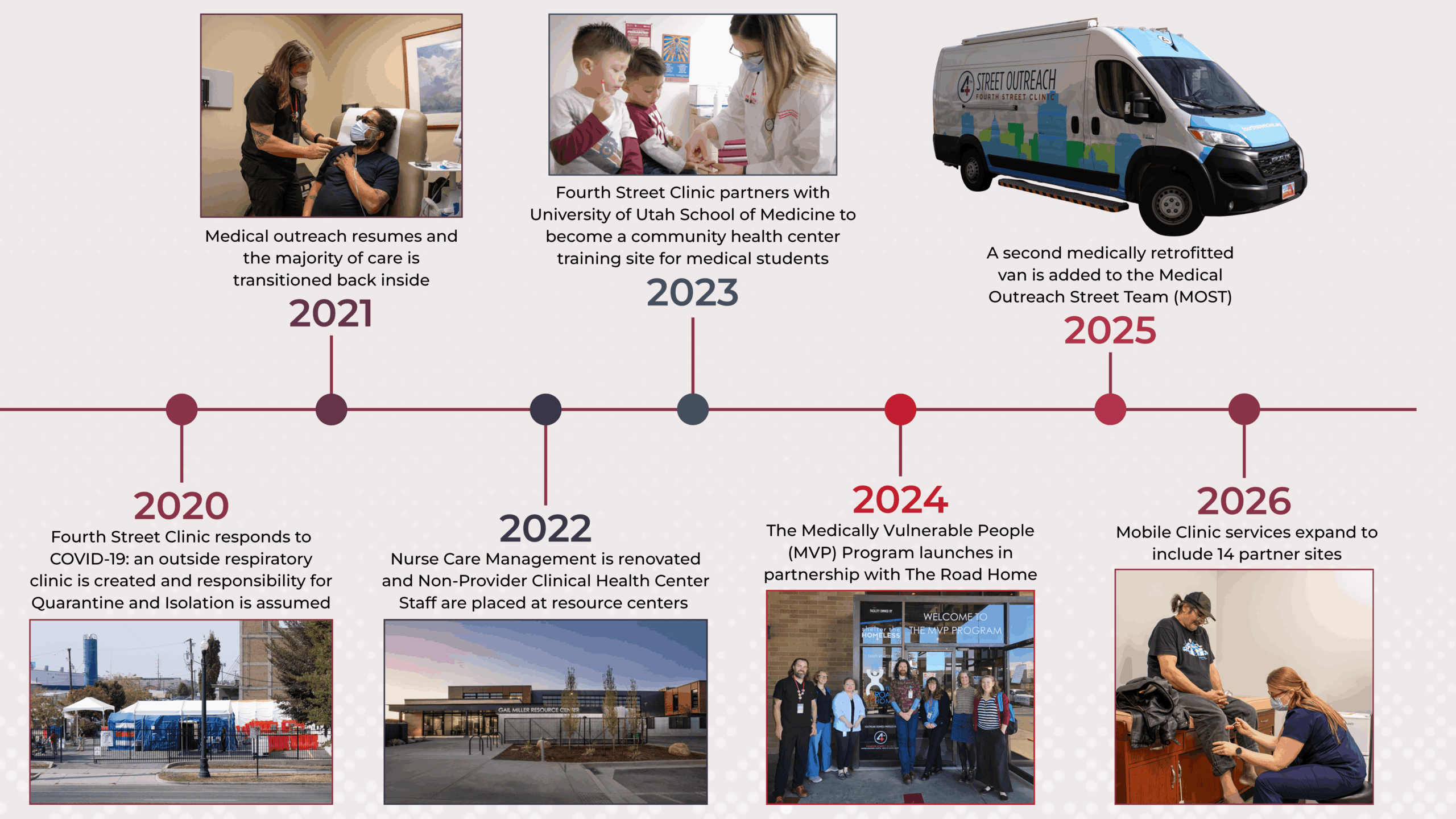
Now, 38 years later, Fourth Street Clinic operates with a staff of over 140 and a network of volunteer providers and health professionals. Fourth Street Clinic serves nearly 6,000 homeless men, women and children each year — with 29,438 medical, mental health, substance abuse, dental and case management visits in 2025. The ALSAM Foundation Pharmacy at Fourth Street Clinic dispensed 103,605 medications in 2025, a 39% increase from 2023.
Fourth Street Clinic is a major partner in ending homelessness, promoting not only community health but achieving across-the-board health care savings by increasing access to primary care.

DONATE

CONTACT US

SERVICES OFFERED